
Islam 101
Basic Beliefs
Islam is a monotheistic Abrahamic faith practiced by more than 1.9 billion people around the world, making it the second-largest religion globally. The word Islam means “submission to the will of God,” and a follower of Islam is called a Muslim. Muslims believe in one, all-powerful, and compassionate God—called Allah in Arabic. They recognize a long line of prophets that includes Adam, Noah, Abraham, Moses, and Jesus, with Prophet Muhammad (peace be upon him) as the final messenger. Islam is not a new religion, but rather a continuation of the monotheistic tradition.
Qur’an and Hadith
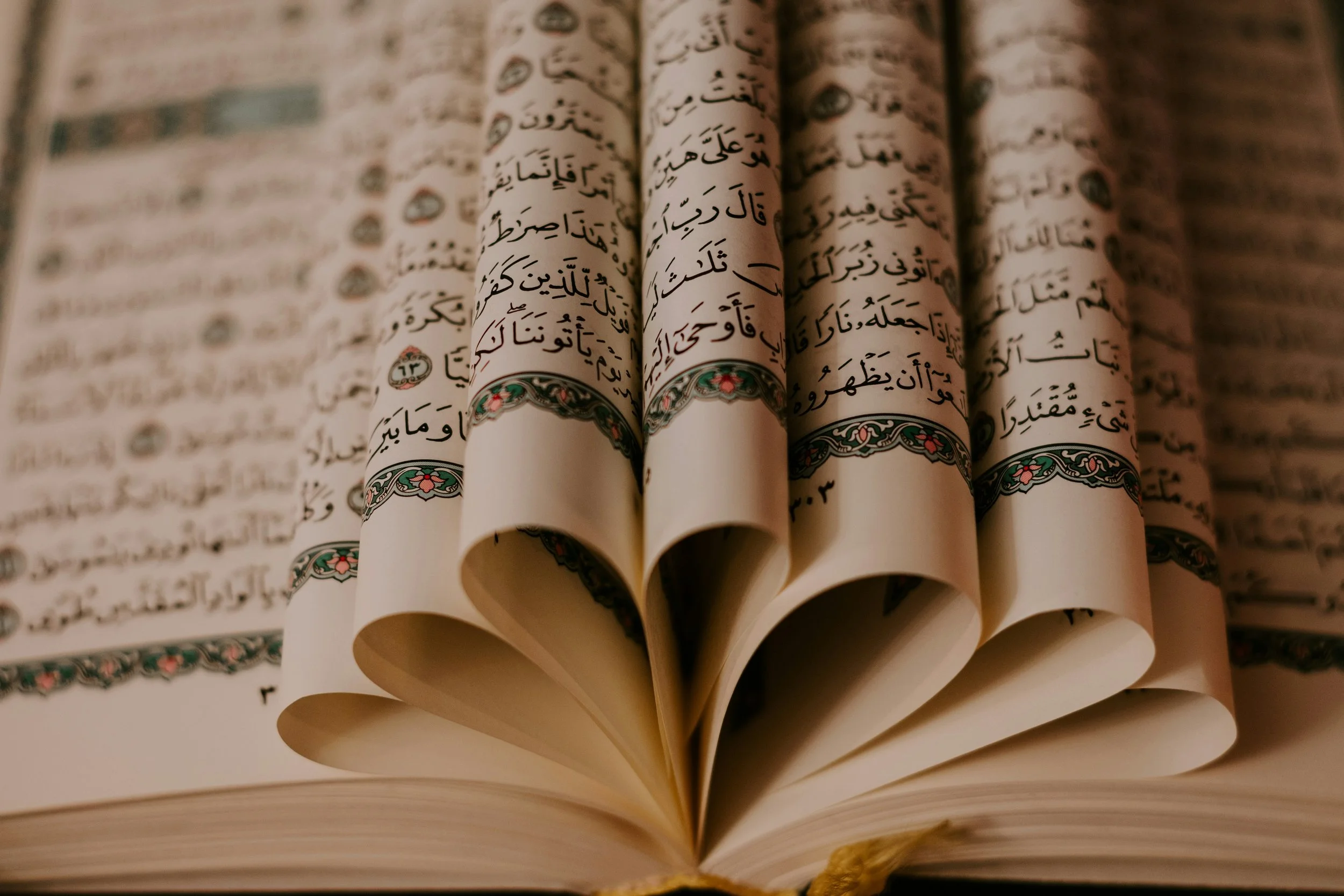
The Qur’an is Islam’s holy book. Muslims believe it is the direct word of God, revealed in Arabic to the Prophet Muhammad over a period of 23 years. Alongside the Qur’an,
Muslims also follow the Hadith, which are sayings and actions of the Prophet Muhammad, as a guide for living a moral and faithful life.
Global Presence
While Islam began in the Arabian Peninsula in the 7th century CE, Muslims today come from every part of the world. The largest Muslim populations are in countries like Indonesia, Pakistan, India, Bangladesh, Nigeria, and Egypt. In fact, most Muslims live outside the Middle East.
Muslims are ethnically and culturally diverse. They speak many languages, live in different political systems, and have a variety of cultural customs—but are united by their faith.
Two Main Branches
There are two main branches of Islam. Sunni Islam is the largest group, making up around 85–90% of Muslims worldwide. Shia Islam makes up about 10–15% and is most prominent in countries like Iran and parts of Iraq and Lebanon.
While they differ in some theological and historical interpretations, both groups share the same core beliefs and recognize the Quran as their holy book.
Women in Islam
Islam introduced many rights for women in the 7th century, including rights to inheritance, property ownership, education, and consent in marriage. Cultural practices and legal systems may differ across countries, but in Islam, both men and women are seen as spiritually equal in the eyes of God.
Modesty is encouraged for all Muslims, and some Muslim women choose to wear the hijab (headscarf) as an expression of faith and modesty.
Ethnic Diversity in Islam
Muslims live all over the world and come from an incredibly diverse range of cultures, ethnicities, and languages. While Islam originated in the Arabian Peninsula, the majority of Muslims today are not Arab. The largest Muslim populations are found in countries like Indonesia, Pakistan, India, and Bangladesh—regions far from the Middle East. In fact, Arabs make up less than 20% of the global Muslim population. Muslims can be African, Asian, European, Latin American, or North American, and they speak languages as varied as Swahili, Urdu, Turkish, Malay, Persian, and English. This global presence reflects the universal nature of Islam as a faith that transcends geography, race, and nationality.
FAQs
-
No. While Islam began in Arabia, Muslims come from all over the world and reflect many different cultures. Only about 20% of Muslims are Arab.
-
“Allah” is simply the Arabic word for “God.” Muslims believe in the same monotheistic God worshipped in Judaism and Christianity.
-
Yes. Muslims believe Jesus (Isa in Arabic) was a prophet born of the Virgin Mary. They respect him deeply but do not believe he is divine or the son of God.
-
The Quran is the holy book of Islam, believed to be the literal word of God revealed to the Prophet Muhammad.
-
Yes. Islam introduced rights to women in areas like education, inheritance, and consent in marriage over 1,400 years ago. Cultural practices vary, however, and do not always reflect Islamic teachings.
-
"Jihad" means “struggle” or “striving.” It primarily refers to the internal, spiritual struggle to live a good and ethical life—not violent extremism, as often portrayed in the media.
-
Ramadan is a sacred month during which Muslims fast from dawn to sunset, refraining from food, drink, and negative behavior. It’s a time of self-reflection, worship, and community.
Glossary
-
Arabic word for God.
-
The holy book of Islam.
-
Recorded sayings and actions of Prophet Muhammad.
-
The final prophet in Islam, through whom the Quran was revealed.
-
A monotheistic religion meaning “submission to God.”
-
A follower of Islam.
-
Ritual prayer performed five times a day.
-
Required charitable giving (usually 2.5% of wealth).
-
Fasting during Ramadan.
-
Pilgrimage to Mecca, required once in a lifetime if financially and physically able.
-
A modest covering often worn by Muslim women; can refer to the headscarf or broader concept of modesty.
-
Permissible under Islamic law; often used in reference to food.